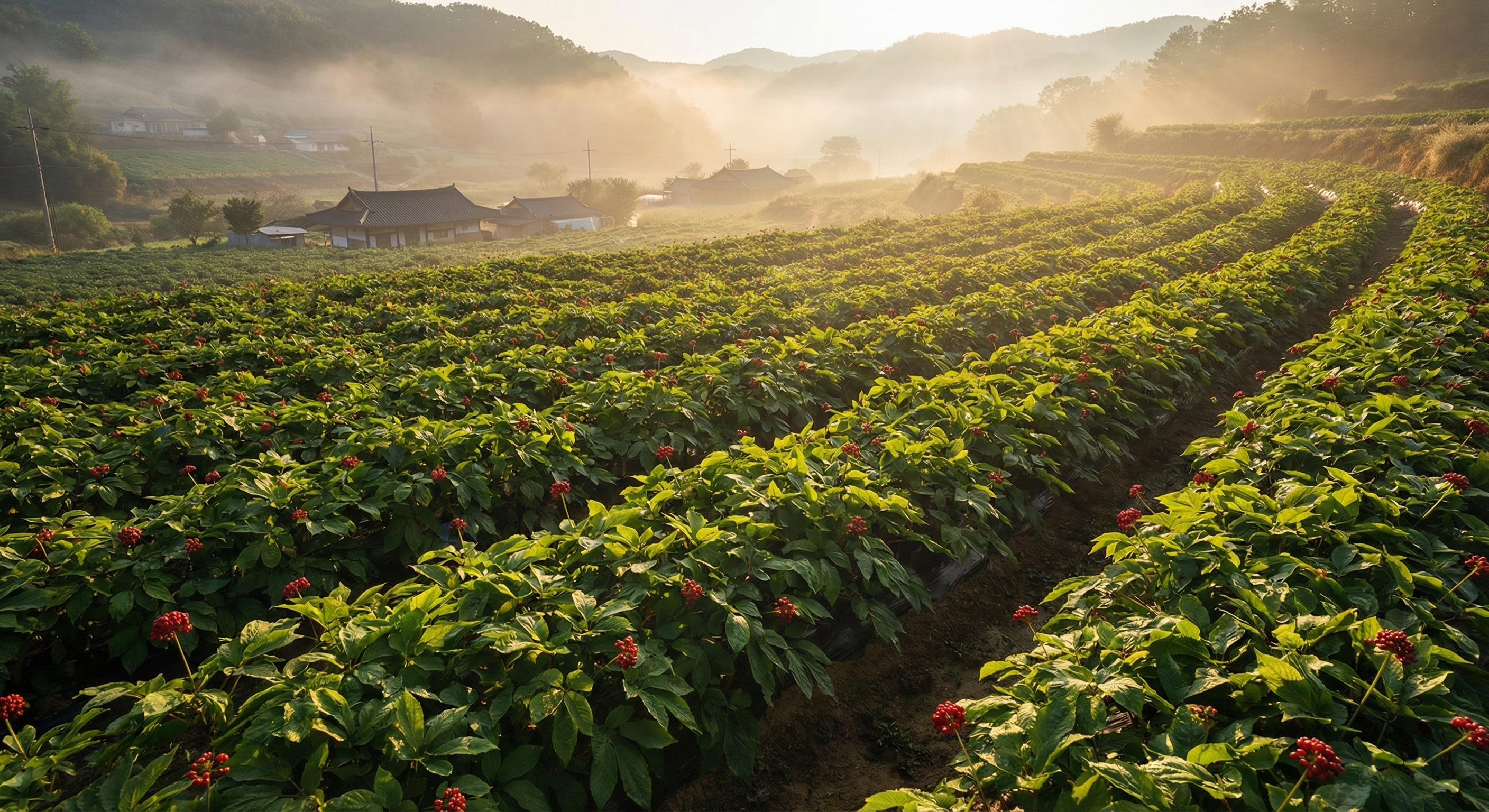
Ginseng field background

Four years of waiting.
One single week.

That is how long ginseng takes to bear fruit

The story of a ginseng berry backed by 25 years of research and patents in four countries

0mg/g

Ginsenosides, the key compounds of ginseng — 67.18 mg per gram,
roughly 13 times the concentration of ordinary red ginseng extract

2 human studies
4 countries with patents granted or filed
25 years of ginseng berry research
100% Ginseng berry extract · nothing added

Why the berry, of all things?

Born of the same plant,
an entirely different treasure

Say ginseng and everyone pictures the root. It has been that way for thousands of years.
But the red berry — four years in the making, open for a single week — holds compounds the root simply does not.

🍒

Compounds the root does not have

The ginseng berry is rich in Re and Rd, compounds hard to find in the root. Analyzed side by side, the berry's Re content runs 4 to 6 times that of the root. The same plant, a different treasure.

— Compositional analysis, international journal (2009)

An age that wants to grow older slowly

"Slow aging" is a familiar phrase now. As interest in the pace of aging has grown, researchers have begun looking past the ginseng root to the berry. Human studies are steadily accumulating.

— See the research library below

🔬

We say only what we can stand behind

Rather than telling you it is good, we show you what is there: compound figures from accredited laboratory reports, and studies published in international journals. The judgment we leave to you.

— This is a research information site and does not sell products

🏛️
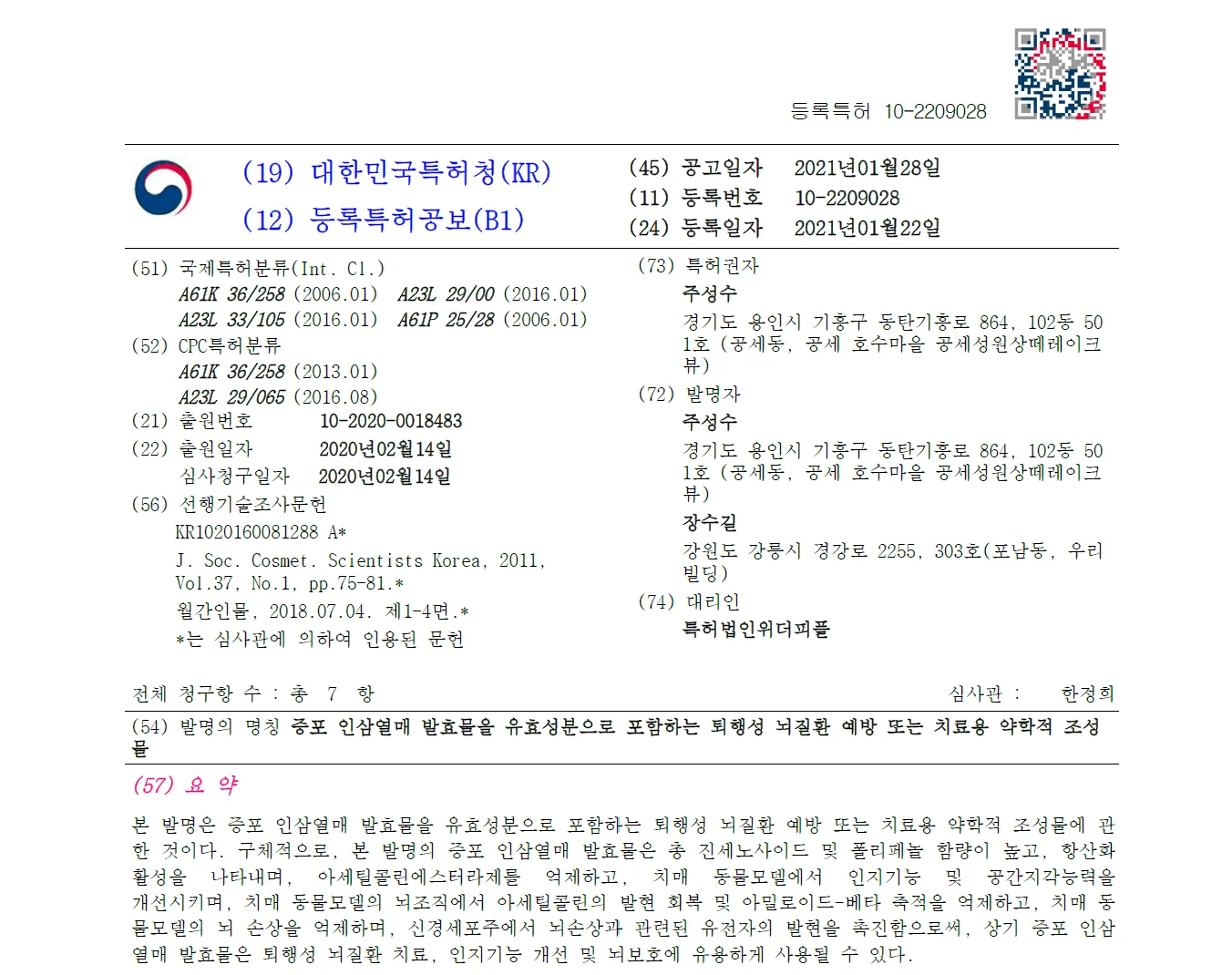
This berry research is formally registered with the Korean Intellectual Property Office Patent KR10-2209028 | Inventor: Prof. Seong Soo Joo (Gangneung-Wonju National University) | Granted in the US · Filed in Europe and China

Our Story

Twenty-five years ago,
a pharmaceutical scientist asked:
"Why is everyone looking only at the root?"

Ginseng must grow four years before it bears fruit.
And then for only one week.
This red berry, once stripped for seed and discarded,
was studied by Prof. Seong Soo Joo for 25 years.
That work became a national research program,
and then patented technology in four countries.
Today the technology takes two paths.

🏥

The pharmaceutical path

Huscion

A biotech venture founded by Prof. Joo.
It is preparing clinical trials
for drug candidates based on
ginseng berry extract

🌿

The food path

2H&G

The same patented technology,
made into a food anyone can
reach for in daily life.
This site tells that story

"It took 25 years to recognize something good.
Passing it on has only just begun."
Why this extract

A berry this rare, run through
the patented process, leaves
only a very small amount

Hundreds of kilograms of ginseng berry become just a few grams of concentrate through the patented process.
How concentrated and how rare that small amount is, you know the moment you try it.

🌿

A genuinely rare raw material

A berry that appears for one week after four years of growth. Less than 5% of the total harvest is selected as high-grade extraction material.

⚗️

Patented bioprocess

Extracted under patent KR10-2209028, the key ginseng compounds remain at roughly 13 times the concentration of ordinary red ginseng extract — a level conventional extraction struggles to reach.

Small in volume, different in kind

One taste and you understand. This intensity is what 25 years of research and a patented process produced. The point is not volume — it is concentration.

Why only 25 g?

800mg × 30days = 24g

One spoonful a day. 25 g is exactly one month.

"It lasted exactly a month" — a note buyers keep repeating

What is inside?

100% ginseng berry extract

  • No licorice
  • No purified water
  • No synthetic preservatives
  • No excipients

Bottled and produced at a Korean pharmaceutical OEM facility

Research library

The plain-language summary alone is enough.
For those who want to go deeper, the source details are folded away below.

2 human studies

The ginseng berry has reached the stage of human research

Studies with 195 and 116 adult participants have been published in international journals. Tap to read more.
Human RCT — metabolic health
Human subjects · 195 participants

Effects of Ginseng Berry Saponins on Glucose Metabolism of Patients with Prediabetes: A Randomized, Double-Blinded, Placebo-Controlled, Crossover Trial

Journal: Phytomedicine (2024) SCI

Design: Randomized, double-blind, placebo-controlled crossover; 195 adults

👥 A randomized, placebo-controlled study testing ginseng berry saponins directly in humans was published in an international journal in 2024

📖 Following a 12-week placebo-controlled RCT in the Journal of Ginseng Research (2016), the ginseng berry has moved beyond cell and animal work to become a material with accumulating human research

※ These results reflect the specific extract and dose used in that trial and do not indicate the efficacy of any particular product.

Human RCT — midlife vitality
Human subjects · 116 participants

Efficacy and Safety of Ginseng Berry Extract in Treating Andropause Symptoms: A Randomized, Double-Blind, Placebo-Controlled Clinical Trial

Journal: The World Journal of Men's Health (2025)

Design: Randomized, double-blind, placebo-controlled; 116 men · 8 weeks · ginseng berry extract 700 mg/day

🧑‍🔬 The most recent human study testing ginseng berry extract on its own (2025)

📈 A placebo-controlled design addressing quality-of-life measures in midlife — ginseng berry extract itself is now the subject of clinical research

※ These results reflect the specific extract and dose used in that trial and do not indicate the efficacy of any particular product.

Cell and animal studies

Re and Rd — the compounds neuroscientists noticed

From Prof. Joo's 2014 paper to the most recent review in 2026, the research keeps going.
Paper — neuroscience
Cell and animal study

Ginsenoside Re and Rd Enhance the Expression of Cholinergic Markers and Neuronal Differentiation in Neuro-2a Cells

Journal: Biological & Pharmaceutical Bulletin, Vol.37, No.5, pp.826–833 (2014) SCI

Corresponding author: Seong Soo Joo, Gangneung-Wonju National University

🧠 Ginsenosides Re and Rd were detected in brain tissue six hours after oral administration — HPLC analysis following saline perfusion (Fig. 7 of this paper)

🔬 Expression of the cholinergic genes ChAT and VAChT increased significantly

💡 "Re and Rd are selective candidates for upregulation of the expression of cholinergic markers"

📚 Research since: a comprehensive review of Rd neuroprotection (Molecules, 2026) and a review of ginsenosides in the nervous system (IUBMB Life, 2024) — work on Re and Rd continues actively today

※ This is a cell and animal study result.

Animal studies

Animal studies on the body's balance

Two animal studies, on blood glucose and on the liver, have been published in academic journals.
Paper — metabolic research
Animal study

Steam-Dried Ginseng Berry Fermented with Lactobacillus plantarum Controls the Increase of Blood Glucose and Body Weight in Type 2 Obese Diabetic db/db Mice

Journal: Journal of Agricultural and Food Chemistry (JAFC), ACS Publications (2012) Top-tier SCI

Corresponding author: Seong Soo Joo, Gangneung-Wonju National University

🩸 A study observing blood glucose and body weight in diabetic model mice given ginseng berry extract

🛡️ Changes in immune cell activity and glucose transporter (GLUT1) expression were also reported

※ This is an animal study result.

Paper — liver research
Animal study

Antihepatotoxic Effect of Ethanol Extracts from Steam-Dried Ginseng Berry on D-galactosamine/LPS-sensitized Mice

Journal: Korean Journal of Food Science and Technology, Vol.49, No.6, pp.676–684 (2017)

Corresponding author: Seong Soo Joo, Gangneung-Wonju National University

🫀 A study observing liver injury markers (AST, ALT and others) in an acute hepatotoxicity mouse model

🌿 The key compounds Re and Rd, together with linoleic acid, were reported as playing the main role

※ This is an animal study result.

Animal studies

A field just opening: the eye

In 2023, a study on the eye (retina) appeared as well.
Paper — eye health
Animal study

Ginsenoside Re Mitigates Photooxidative Stress-Mediated Photoreceptor Degeneration and Retinal Inflammation

Source: PubMed Central open-access paper (2023), PMID 37326907

Study type: In vivo (animal) + cell experiments

👁️ An in vivo study observing ginsenoside Re and retinal tissue under light-induced oxidative stress (2023)

🌿 Re is scarce in the ginseng root and abundant in the berry — across three Korean ginseng cultivars, berry Re measured 4 to 6 times that of the root (Natural Product Communications, 2009)

※ This is a cell and animal study result and does not indicate product efficacy.

Patents

Technology examined in four countries

Granted in Korea and the United States, filed in Europe and China. You can view the patent certificate for yourself.
Patent
Korean patent certificate KR10-2209028

Patent KR10-2209028

Title: Pharmaceutical composition for the treatment or prevention of neurodegenerative disease

Inventor: Prof. Seong Soo Joo (Gangneung-Wonju National University)

Technology: Bioprocess for high-concentration extraction of Re, Rd and Rg3 from ginseng berry (yield under 5%)

🇰🇷 Korea KR102209028B1 — granted
🇺🇸 United States USPTO US11622983B2 — granted
🇪🇺 Europe EPO EP3865142A1 — filed
🇨🇳 China CN113730449A — filed

2H&G is the only company in the world applying this technology to a product.

Red ginseng is steamed and dried too

This is not simple steaming — the bioprocess from 25 years of research is the point

Red ginseng / conventional steamed products

Steaming and drying
Powdered · concentrated

General health food grade

VS

Patent KR10-2209028

Steaming
Patented bioprocess
(process details undisclosed)
High-concentration extract

Recognized by patent as a pharmaceutical composition

Patent claim 6 — as registered with the Korean Intellectual Property Office

A composition manufactured by this bioprocess is registered with the patent office as a pharmaceutical composition for the prevention or treatment of the following neurodegenerative diseases:

Alzheimer's diseaseParkinson's diseaseHuntington's diseaseMild cognitive impairmentSenile dementiaDementia with Lewy bodiesFrontotemporal dementia

※ This cites a fact registered with the patent office. This product is a general food, and the above does not indicate any disease prevention or treatment effect of the product. The cited patent research is based on cell and animal experiments.

Test reports

The full compound profile, nothing hidden

Straight from the accredited laboratory report, set side by side with red and black ginseng.
Health functional food vs. ginseng berry extract

We disclose the compounds a health functional food label cannot fully show

Health functional food (ginseng root)
2.5
mg/g
Under MFDS labeling rules
only the sum of Rg1+Rb1+Rg3 may be stated
VS
Ginseng berry extract (general food)
67.18
mg/g
All 10 compounds disclosed
Re · Rd · Rg3 · Rg5 and more

General foods face no labeling restriction. We have nothing to hide, so we disclose all of it.

Compound comparison

Ginsenoside content comparison

Compound Ginseng berry extract Red ginseng Black ginseng
Rg3 23.62 mg/g 0.87 6.07
Re 2.21 mg/g trace trace
Rd 12.63 mg/g trace trace
Rg5 9.08 mg/g 1.26 7.23
Total 67.18 mg/g ~5 ~10

Ginseng berry extract source: Geumsan Ginseng and Medicinal Herb Industry Promotion Agency test report (2025.08.12)

Red and black ginseng source: Park et al., Pharmaceutics 2022; PMC8803428 — Pharmacokinetics of Ginsenosides from Red Ginseng Extract in Healthy Korean Volunteers

Berry and root comparison source: Natural Product Communications 2009; PMID 19731589 — across three Korean ginseng cultivars, berry Re content measured 4 to 6 times that of the root

※ These figures are raw-material analysis results and do not indicate product efficacy.

Why a general food

"Not for any lack of compounds"

  • MFDS standard: The ginseng berry is not listed as a health functional food ingredient. That is a limit of the regulatory framework, not of the compounds.
  • Our choice: We offer 100% pure ginseng berry extract as a general food.

※ The studies presented are academic research on the raw material and do not indicate the efficacy of any particular product.

Behind this research,
there is one person

Prof. Seong Soo Joo

Prof. Seong Soo Joo 주성수

  • Professor, Gangneung-Wonju National University · Ph.D. in Pharmacy (Immunology)
  • 100+ international papers · 40+ patents · 50+ national research projects
  • Selected researcher, Korea Dementia Research Project · 2018 Bio Korea Commendation for the Health Industry
View full profile
  • Professor, Dept. of Marine Molecular Biotechnology, Gangneung-Wonju National University
  • Ph.D. Pharmacy, Chung-Ang University (Immunology)
  • M.S. Medical Microbiology, Long Island University (New York, USA)
  • 100+ International Papers  |  40+ Patents  |  50+ National Research Projects
  • Selected — National Dementia R&D Program (Korea)
  • 2018 BioKorea Health Industry Merit Award (Chungbuk Governor's Citation)

What people say

★★★★★

"I have taken it consistently for two years. Mornings are easier, and I feel more energy day to day."

— A., two-year user

★★★★★

"Losing focus at work was my worry. A friend recommended it, and now I recommend it to others."

— B., office worker (50s)

★★★★★

"My husband and I take it together. We were looking for good raw ingredients and found the ginseng berry."

— C., homemaker (60s)

★★★★★

"Drinking with colleagues felt different. I joked that I wanted to complain about not getting drunk — but I meant it."

— D., office worker (40s)

※ Individual experiences, unrelated to any product effect.

Did the story stay with you?

Products made with the same patented technology are available on the Naver Smart Store

Go to the Naver Smart Store →

If you have questions,
please get in touch

Please enter your name.

Please enter your contact details.

Your inquiry has been received.
We will be in touch shortly.

Naver Store → Naver Smart Store →